For the past year, I've been a Developer Advocate at 100ms, a company that focuses on live audio-video. My job involves helping developers integrate our SDKs and APIs into their products.
Though I'm still learning, I believe I can offer insights to those wanting to begin in Developer Relations, especially in Developer Advocacy.
Who is a Developer Advocate?
A Developer Advocate acts as a bridge between a product team and developers. They have a two-way role: producing content to reach out to developers and passing on feedback from developers to the internal team.
As a Developer Advocate, my job is to represent the needs of developers and focus on improving their experience to ensure they can easily adopt our technology.
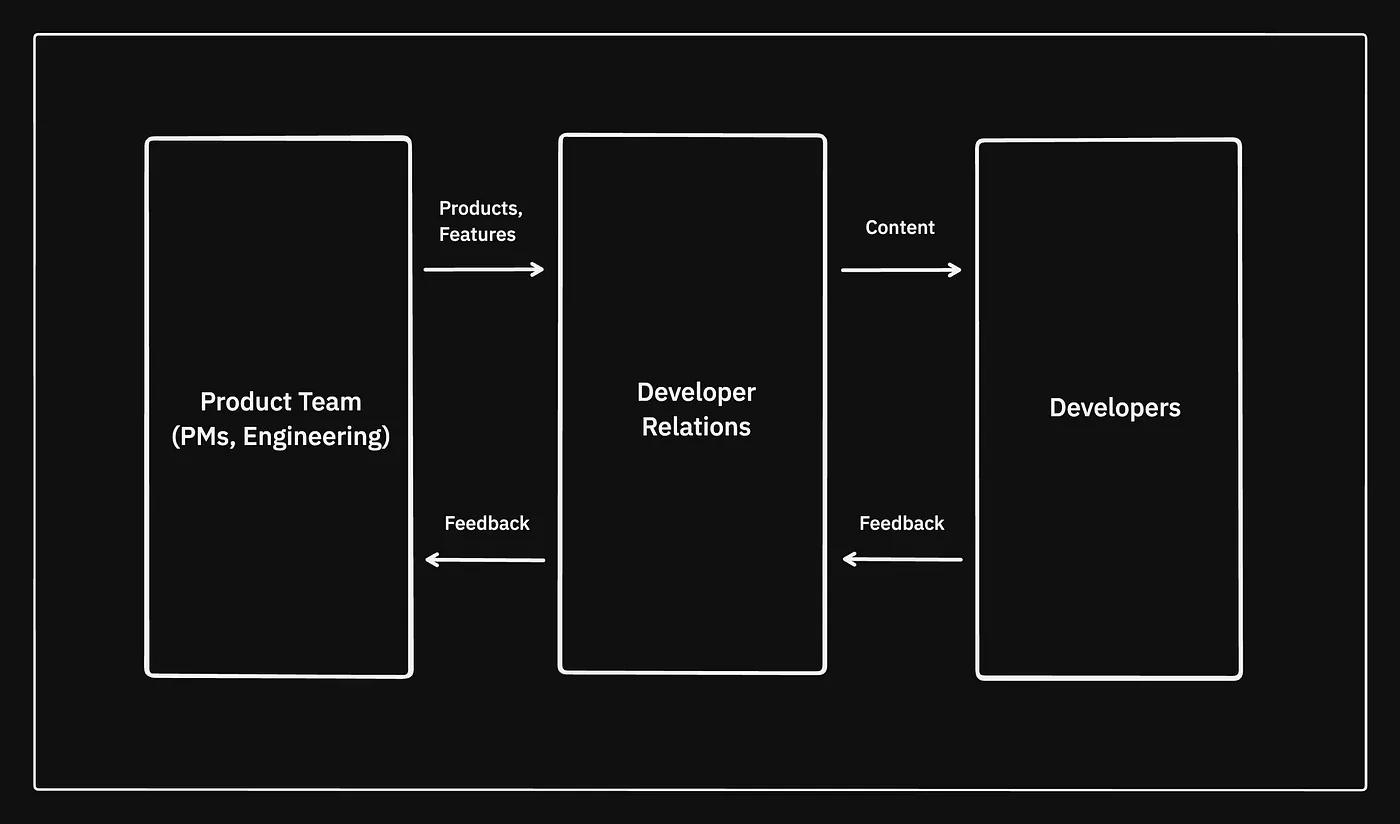
Developer Advocates act as a bridge between a product team and developers.
As explained in a blog on freeCodeCamp:
A Developer Advocate is someone who truly advocates for developers, not just a platform. Developers should be the Developer Advocate's top priority.
What does a Developer Advocate do?
As a Developer Advocate, our goal is to support developers throughout their journey: from discovering the product and learning how it works, to adopting or integrating it, and finally recommending it to others.
The Adoption Funnel
Developer Advocates play a key role in each stage of a product's adoption process. The images below illustrate the various steps from discovery to integration and how Developer Advocates can assist.
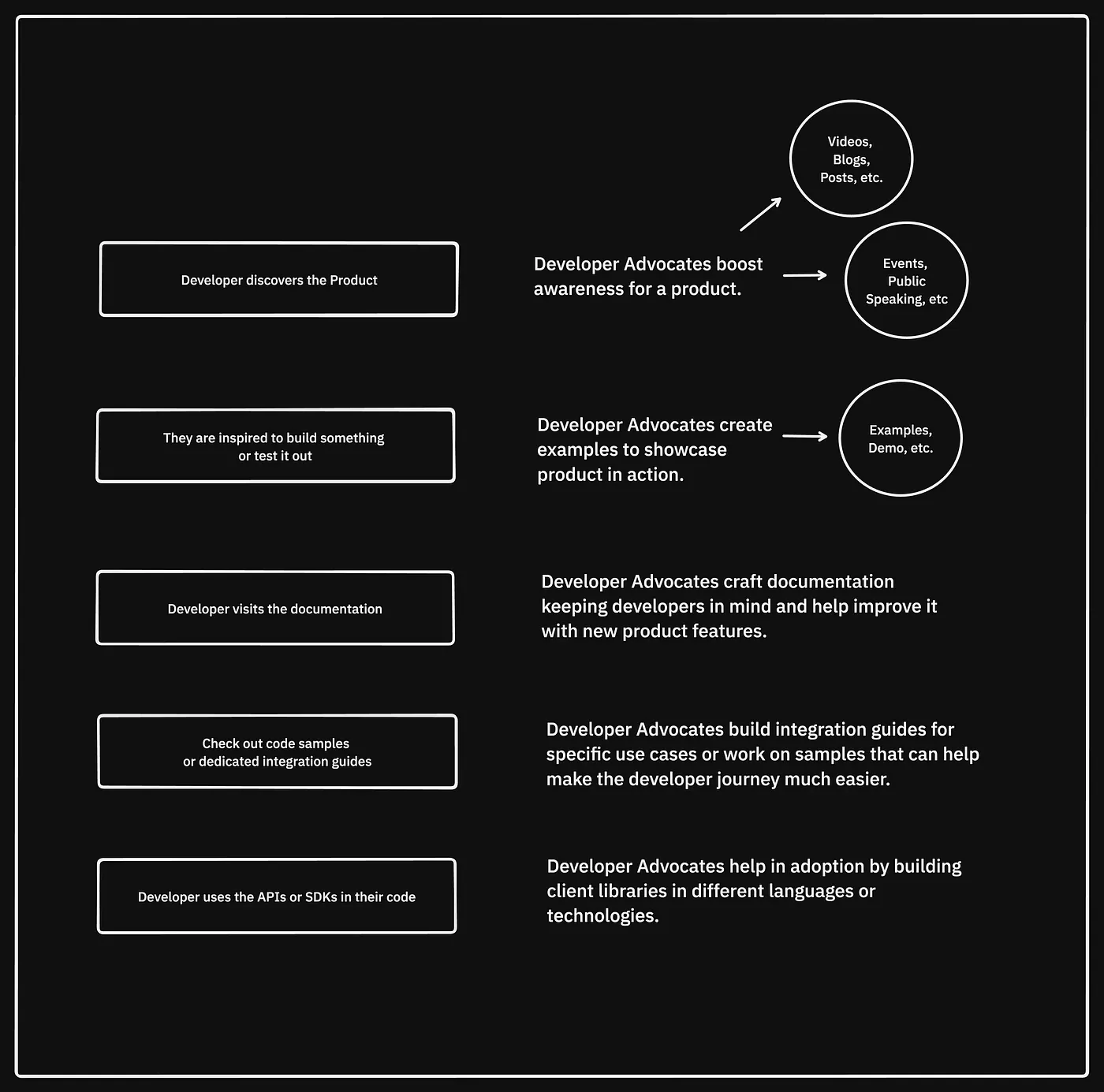
Developer Advocates' role in each stage of a product's adoption process.
As a Developer Relations professional, our focus is on educating and empowering developers. This involves various approaches, such as creating introductory content to attract developers, delving deeper into product features, and partnering with other organisations.
How do I approach this?
Firstly, I have focused on creating a lot of top-of-the-funnel content, whether as YouTube videos or blog posts. Attracting developers begins with creating introductory content that piques their interest like the following:
For a live audio-video company, explaining concepts like WebRTC and providing tutorials on building a video calling app can draw developers into your ecosystem. This is helpful for developers to discover our offerings and assists marketing with SEO.
Imagine you were looking to integrate WebRTC into your Flutter app and stumbled upon my piece on Flutter WebRTC. It would help you learn how to use WebRTC and implement real-time audio-video communication in a Flutter app. Moreover, if the developer is interested, we could assist them with our scalable offering.
Speaking at events can also help increase product discovery. By sharing insights and expertise, you can capture the attention of developers who are seeking solutions like yours. I have spoken at various events. Often, I have met people who are in the process of integrating and come up for help. Others would have our product's name in mind if a use case ever arises.
Additionally, I have worked on developing some impressive demos. Demonstrating the capabilities of your technology through engaging demos is essential. It showcases the capabilities of your technology and sparks interest among developers.
For example, recently I worked on Polls AI, a project to take shapes off the whiteboard and converts them to live polls. For any edtech customers, it could be great to test out the product and learn that we support different use cases. For developers, it would spark creativity to use 100ms in their own projects.
Collaborating with other companies can also expand our reach and provide valuable resources. For this project, we collaborated with tldraw, and their team shipped some amazing demos, helping both our platforms market it better.
Whenever there's a new feature, like Timed Metadata in live streaming, I have worked on blogs to assist developers in understanding and implementing it into their products. Highlighting specific features can address developers' curiosity and also showcase the product's capabilities.
A significant part of my job is also ensuring that our documentation is clear and comprehensive. Developers rely on documentation to understand how to use your product effectively, so investing in its improvement is crucial.
Furthermore, I have worked on integration guides tailored to specific functionalities, like polls, and templates such as our edtech template to accommodate some common requests and streamline the integration process for developers, making their experience smoother.
How to become a Developer Advocate?
A lot of companies that build for developers, whether startups or established big corporations, hire for developer relations roles. These roles might have different names and duties depending on the requirements of the companies but can be put under the DevRel umbrella.
It reminds me of the famous quote that goes something like:
DevRel is whatever your company wants it to be.
But, before I get into how to become one, it might be worth evaluating your reasons for wanting to be one. A good read on the subject is article titled Everyone Can Do DevRel (But Should They?).
As mentioned, there are multiple facets of DevRel. Since it is an amalgam of code, content, and community, it is good to have a combination of multiple skills.
For me, what worked was that I have been a developer first. I started out with mobile development, focusing on cross-platform development, and became proficient at it. I am recognised as a Google Developer Expert for Flutter and Dart. While I was learning and building apps, I would share my knowledge through blog posts or YouTube videos.
This helped me build my content muscle while also helping improve my technical proficiency. An essential skill is being able to explain complex technical concepts in a clear and concise manner that is easy for the audience to understand, and technical writing helped me get better at it.
I also spoke at a number of events with no specific goals in mind, just to share what I knew. I was able to present to large audiences, helping me conquer stage fright and become more comfortable with the mic.
As such, I was connected with many event organisers and met developers at various events. I also had a Discord community where I would interact with other developers and stay connected to the community.
If there are any lessons, I would suppose it would be to build these skills by focusing on one aspect initially.
For example, if you are transitioning from a full-time software development role to DevRel, you could start by writing technical articles simplifying concepts for beginners. If you are a college student, focus on becoming technically sound and get involved in communities to better understand the space. If I were looking to apply to a company, I would focus on building with their products and sharing my knowledge to demonstrate why I might be a fit for the role.
While this article was based on personal experience, I hope it helps you get started with DevRel. Some resources that I think might be helpful for further reading are listed below.
- A Developer Journey Map by DevRel.Agency is a visualisation that identifies the path a developer follows and experiences. It's a valuable tool in Developer Relations because it helps you think holistically about the experience from the developer's perspective.
- Tessa Kriesel's DevRel Strategy Breakdown, a guide to help Developer Relations professionals struggling to define strategy and measure success.
- Measuring Developer Relations, a comprehensive article by swyx that explores the complexities of evaluating the effectiveness of developer relations (DevRel) efforts and offers valuable insights based on the author's experiences and observations.
- Lee Robinson has authored multiple posts on Developer Relations and Developer Experience: What is Developer Relations?, On Developer Marketing, Make Something Developers Want, and What Makes a Great Developer Experience?.
That is all. Thank you for reading!